Some families have experienced difficulty viewing this blog, so I am moving it to: https://mrsmarchiori.wordpress.com/
Sunday, November 22, 2015

Sunday, November 1, 2015
Addition Pretest Explained
This week, we will be beginning to do our addition tests, but as promised, I am blogging about how to do the addition pretest. I have completed the pretest with adults in mind and would not expect the students to use the same terms I use, but to do their best to explain their own thinking. Some will be able to fully express themselves in writing, others will need to do some of their thinking out loud with an adult. Some will find it helpful to use some of the materials in the classroom. The goal here is to be moving towards a bigger conceptual understanding both of place value and addition.


I have been most impressed by the students thinking during the last week and a half and am thrilled to be able to tell you that while most feel awkward trying to explain the math in writing, they are developing a good understanding of the concepts and are finding ways to express their thinking.


Friday, October 23, 2015
Addition Pretest
Have a look at out addition pretest. It is important that the children begin to put their numeracy thinking into words because ultimately, words are our thinking tools.


We will be finishing writing and working on understanding the questions on the pretest next week. So far, I am impressed by the high quality thinking that is going on in room 207! Next weekend, I will blog about how to answer the questions on the test. In the meantime, it would be great if parents could puzzle over the answers with their children - not to test their abilities, but to get some deep thinking discussion going. Have fun with it. After all, fun is what math is all about!
Saturday, October 17, 2015
Mrs. Wilcott and Friday Journals

I am thrilled to welcome Mrs. Wilcott as our student teacher this year. The children are enjoying getting to know her and I am very pleased with how thoughtful, kind, and knowledgeable she is. Welcome Mrs. Wilcott!
Every Friday the children reflect upon one activity that we did during the week and create a piece of art to represent their experience. They then write about what they have represented and why it was important. These pieces of art are becoming increasingly detailed and expressive. Here are some of the images from this week:
 |
| The Book Fair |
 |
| The Book Fair |
 |
| Drago (base 6 math) |
 |
| Drago (base 6 math) |
 |
| Sir Sloth-a-lot's base 4 math |
 |
| Jake (base 8 math) |
 |
| Mrs. Wilcott
Don't worry if you don't see your child's art. There is a whole year for sharing. Also, I don't take pictures of work that is glued directly into the children's scrapbooks as they will be able to take home their original art. When I have taken a picture, it is printed (due to a lack of funds, in black and white), and glued into their books with their writing.
|
Place Value
If you talk to almost any elementary teacher about math, place value will come up as a topic. Place value refers to our number system. We have ten digits: 0,1,2,3,4,5,6,7,8,9, and indicate the value of those digits with their placement in a number. The 9 digit in 2,974, for instance, is worth 900. Undoubtedly, the reason we have ten digits in our counting system is that we have ten digits (otherwise known as fingers) on our hands.
The problem with place value is that it is hard for young children to understand such an abstract concept. They can often tell you that the 9 is worth 900, but they don't have any idea of what 900 means and they don't really understand that place value is a thing.
To counter this, this year we have done some counting in other bases. This is Drago:

Drago teaches math to dragons and speaks with a terrible Russian accent. He has three digits on each hand and he has a problem. In his number system, he uses tally marks:

Drago finds that math with tally marks takes a long time and is very awkward. The children taught Drago to count like this: 1, 2, 3, 4, 5, 10. Like us, the last digit on his hand has a value of ten. Mathematicians would say that Drago counts in base 6.


 Jake
Jake
 Sir Sloth-a-lot
 Parrot (as yet unnamed)
The problem with place value is that it is hard for young children to understand such an abstract concept. They can often tell you that the 9 is worth 900, but they don't have any idea of what 900 means and they don't really understand that place value is a thing.
To counter this, this year we have done some counting in other bases. This is Drago:
Drago teaches math to dragons and speaks with a terrible Russian accent. He has three digits on each hand and he has a problem. In his number system, he uses tally marks:

Drago finds that math with tally marks takes a long time and is very awkward. The children taught Drago to count like this: 1, 2, 3, 4, 5, 10. Like us, the last digit on his hand has a value of ten. Mathematicians would say that Drago counts in base 6.

Drago continues counting like this:
1,2,3,4,5,10,11,12,13,14,15,20,21,22,23,24,25,30... but when does he get to 100. I'll leave that for you to think about, but feel free to check in with me or leave a comment if you think you have it right or just plain get stuck.
In base ten, we use place value blocks to help us understand what is happening when we "operate" on numbers. They look like this:
Drago wanted to take some place value blocks back to his students, but of course, they had to be in base six. The children drew them like this (not all attempted the thousands block):
The results were, quite frankly, thrilling. Every single child could count in base six and almost all of them could independently draw ones, tens, and hundreds blocks.
The next day, the children met some new characters. We used their digits to count too and made more blocks in their bases.
JakeSir Sloth-a-lotParrot (as yet unnamed)
Some children, by the end of the second day, were even attempting to add in different bases. WOW!
Next week, we will return to looking at base 10 and it is my hope, that the children will begin to appreciate our counting system in a new way and will be more open to seeing the patterns and inherent beauty in our number system.
Why Math Is So Important (and why I don't send home math homework)
I wasn't very good at school math when I was little. I took a long time to memorize my times tables and hated the endless pages of questions. I remember vividly the first time I did well on a math task at school. My grade six teacher had a star chart for students who did well in math. A gold star for a perfect score and a silver star if you made only one mistake. I yearned for a star.
One day, while sitting over yet another page of very boring multiplication problems (I think they were double digit by double digit), I suddenly realized that the math in front of me was a battle ground. It was odds versus evens, and the odds were the bad guys. I eagerly took my pencil in hand and worked away at each problem to see who would win. When I finished, I took my paper up to be marked and received a perfect score! What made this day memorable was my teacher's response. My teacher looked at me with great suspicion and took out not a gold, but a silver star. The unfairness of that moment is probably why I still remember that episode.
On the other hand, what is important about that day is that the odds versus evens battle stuck with me. I began to notice patterns. I began to see that an odd number multiplied by an even number or an even number multiplied by an even number will always result in an even product, but that odd by odd multiplication will always resulted in an odd answer. Interesting - right?
My parents were never big on homework. They worked full time and were tired at the end of their day. I don't think they had the energy to fight us over homework, but they also felt that we had a right to play. I am so thankful for that. One kind of play, though, was really fundamental to my love of math today.
My dad used to sit at the table with us and we would have fun math talks. We would talk about why some numbers were squares and how fractions worked. I knew about square numbers before I ever heard of multiplication - and I understood how they worked because my dad shared his love of math with us. We never sat around memorizing times tables or doing addition problems, but we talked about math all the time. Thank you Dad!!!
Even in high school, I wasn't a brilliant math student. When a concept interested me, I did really well, but I was no good at the boring stuff. In grade ten we had to write an international math test. That was fun! I remember enjoying all of the challenges and getting really stuck on a problem about trapezoids. I'd never heard of one and after finishing, went back to that page and read the question over and over again, trying to figure out what a trapezoid was.
Some time later, my math teacher came to me with a strange, puzzled expression on his face. He told me that I had received the top score in my class on that test. Mind you, my class had about 20 kids in it, but some of them were incredible math whizzes who could calculate at lightening speed. I thought that was pretty cool, but it didn't really affect my ability to do well in class.
I didn't go on to do much math in university. I took one wonderful statistics course that really made me think about the nature of data. I also took the math for teachers course and worked with some friends who struggled in that course. They didn't have a Dad who made math fun and for them the concepts that we learned that year were a big challenge. For me, they were exciting and I learned a lot by helping my friends understand the big ideas.
I still didn't think that much about math until one day during teacher training, a young woman said to me, "Wow! You want to teach grade 7? I couldn't even do the math." In that instant, I had a shiver of recognition. This woman was in teacher training and, after having graduated from a BC school, obtained a bachelor's degree, and completed the teacher's math course, she did not feel capable of doing grade 7 math, let alone teaching it. We as a school system were doing something fundamentally wrong. I began to seriously question our skills and drills approach to teaching math.
Since then, math has been a huge focus of my own teaching program and research shows that there is little place for skills and drills in developing a numerate society. I don't mean to say that it's not helpful to know your math facts. Of course it is, but there is so much more to it and those math facts help with fluency, but not much with comprehension.
When we teach reading, we teach a skill called decoding which allows children to learn to read the words. We also teach a skill called comprehension that allows children to think about what the words, sentences, paragraphs, and stories mean. Most children can learn to decode quite easily and can read a mile a minute. Many of those children understand very little of what they read. They don't know that their brains are supposed to be engaged while reading, and so, we teach them.
The same holds true for mathematics. Most children can learn to add, subtract, multiply, and divide. These are skills that can be done by rote. Unfortunately, many of those who ace those skills have no idea what's really happening to the quantities they are working with. For this reason, how we teach math in BC is undergoing a fundamental and profound shift. We are moving away, finally, from skill and drills and towards a much more comprehensive understanding of mathematics. This is something to be really excited about, but I understand how frustrating it can be for parents.
What I do much of the time in math class leaves my students' heads reeling. I don't intend for them to fully understand each and every concept, but to learn to play with math much as my father played with me. I want them to begin to see the beauty in math and to look for patterns and relationships between numbers. I want them to see that they are dealing with not just number, but quantity. I want them to be able to do math in their heads and to be able to stop and think about how they just got that answer. I want them not only to be good at arithmetic, but to be numerate. Most of all, I want to make sure that each child has an opportunity to work in his or her zone of proximal development.
If you look back at my post on the zone of proximal development, you will see that much of your math time in school was probably spent in your zone of actual development doing skills and drills on math you had already mastered. Or... if you were one of the unlucky ones, the math lesson went on ahead of you, leaving you feeling like a fool and the math was entirely outside of your zone. Neither of those feels good and the only children who benefit are those smack dab in the middle.
I want my students to feel challenged, but not overwhelmed. I want them to feel like all this stuff is starting to make sense and that they're good at it, but not that it is either too easy or too hard. This is, quite frankly, and exhausting daily dance that I do with my students. There is a huge range of understanding and ability in any classroom and meeting all of those needs requires a great deal of thought and energy. I wouldn't have it any other way though. Each child deserves to become a mathematician in their own right and at their own level.
As you will see in this weekend's blog posts, if I were to send home the work that we do in class, you would be confused and so would your child. That would be extremely counterproductive.
On the other hand, there is something you can do. Look together for patterns, discuss numbers and how amazing they are. Read the blog and talk about the math we do, but don't worry if your child cannot explain it. It's not yet in their zone of actual development, so they probably won't be able to articulate well what we are doing. Begin to see the mathematics of your world as beautiful and so too will your child.
If you're looking for a good math read, Leonard Mlodinow's book, The Drunkard's Walk, (not about a drunkard, but an expression) is a fabulous read that requires no mathematical background. The book is about the nature of randomness and is a lot of fun to read or listen to and will give you a starting place for thinking about mathematical relationships in a new way.
One day, while sitting over yet another page of very boring multiplication problems (I think they were double digit by double digit), I suddenly realized that the math in front of me was a battle ground. It was odds versus evens, and the odds were the bad guys. I eagerly took my pencil in hand and worked away at each problem to see who would win. When I finished, I took my paper up to be marked and received a perfect score! What made this day memorable was my teacher's response. My teacher looked at me with great suspicion and took out not a gold, but a silver star. The unfairness of that moment is probably why I still remember that episode.
On the other hand, what is important about that day is that the odds versus evens battle stuck with me. I began to notice patterns. I began to see that an odd number multiplied by an even number or an even number multiplied by an even number will always result in an even product, but that odd by odd multiplication will always resulted in an odd answer. Interesting - right?
My parents were never big on homework. They worked full time and were tired at the end of their day. I don't think they had the energy to fight us over homework, but they also felt that we had a right to play. I am so thankful for that. One kind of play, though, was really fundamental to my love of math today.
My dad used to sit at the table with us and we would have fun math talks. We would talk about why some numbers were squares and how fractions worked. I knew about square numbers before I ever heard of multiplication - and I understood how they worked because my dad shared his love of math with us. We never sat around memorizing times tables or doing addition problems, but we talked about math all the time. Thank you Dad!!!
Even in high school, I wasn't a brilliant math student. When a concept interested me, I did really well, but I was no good at the boring stuff. In grade ten we had to write an international math test. That was fun! I remember enjoying all of the challenges and getting really stuck on a problem about trapezoids. I'd never heard of one and after finishing, went back to that page and read the question over and over again, trying to figure out what a trapezoid was.
Some time later, my math teacher came to me with a strange, puzzled expression on his face. He told me that I had received the top score in my class on that test. Mind you, my class had about 20 kids in it, but some of them were incredible math whizzes who could calculate at lightening speed. I thought that was pretty cool, but it didn't really affect my ability to do well in class.
I didn't go on to do much math in university. I took one wonderful statistics course that really made me think about the nature of data. I also took the math for teachers course and worked with some friends who struggled in that course. They didn't have a Dad who made math fun and for them the concepts that we learned that year were a big challenge. For me, they were exciting and I learned a lot by helping my friends understand the big ideas.
I still didn't think that much about math until one day during teacher training, a young woman said to me, "Wow! You want to teach grade 7? I couldn't even do the math." In that instant, I had a shiver of recognition. This woman was in teacher training and, after having graduated from a BC school, obtained a bachelor's degree, and completed the teacher's math course, she did not feel capable of doing grade 7 math, let alone teaching it. We as a school system were doing something fundamentally wrong. I began to seriously question our skills and drills approach to teaching math.
Since then, math has been a huge focus of my own teaching program and research shows that there is little place for skills and drills in developing a numerate society. I don't mean to say that it's not helpful to know your math facts. Of course it is, but there is so much more to it and those math facts help with fluency, but not much with comprehension.
When we teach reading, we teach a skill called decoding which allows children to learn to read the words. We also teach a skill called comprehension that allows children to think about what the words, sentences, paragraphs, and stories mean. Most children can learn to decode quite easily and can read a mile a minute. Many of those children understand very little of what they read. They don't know that their brains are supposed to be engaged while reading, and so, we teach them.
The same holds true for mathematics. Most children can learn to add, subtract, multiply, and divide. These are skills that can be done by rote. Unfortunately, many of those who ace those skills have no idea what's really happening to the quantities they are working with. For this reason, how we teach math in BC is undergoing a fundamental and profound shift. We are moving away, finally, from skill and drills and towards a much more comprehensive understanding of mathematics. This is something to be really excited about, but I understand how frustrating it can be for parents.
What I do much of the time in math class leaves my students' heads reeling. I don't intend for them to fully understand each and every concept, but to learn to play with math much as my father played with me. I want them to begin to see the beauty in math and to look for patterns and relationships between numbers. I want them to see that they are dealing with not just number, but quantity. I want them to be able to do math in their heads and to be able to stop and think about how they just got that answer. I want them not only to be good at arithmetic, but to be numerate. Most of all, I want to make sure that each child has an opportunity to work in his or her zone of proximal development.
If you look back at my post on the zone of proximal development, you will see that much of your math time in school was probably spent in your zone of actual development doing skills and drills on math you had already mastered. Or... if you were one of the unlucky ones, the math lesson went on ahead of you, leaving you feeling like a fool and the math was entirely outside of your zone. Neither of those feels good and the only children who benefit are those smack dab in the middle.
I want my students to feel challenged, but not overwhelmed. I want them to feel like all this stuff is starting to make sense and that they're good at it, but not that it is either too easy or too hard. This is, quite frankly, and exhausting daily dance that I do with my students. There is a huge range of understanding and ability in any classroom and meeting all of those needs requires a great deal of thought and energy. I wouldn't have it any other way though. Each child deserves to become a mathematician in their own right and at their own level.
As you will see in this weekend's blog posts, if I were to send home the work that we do in class, you would be confused and so would your child. That would be extremely counterproductive.
On the other hand, there is something you can do. Look together for patterns, discuss numbers and how amazing they are. Read the blog and talk about the math we do, but don't worry if your child cannot explain it. It's not yet in their zone of actual development, so they probably won't be able to articulate well what we are doing. Begin to see the mathematics of your world as beautiful and so too will your child.
If you're looking for a good math read, Leonard Mlodinow's book, The Drunkard's Walk, (not about a drunkard, but an expression) is a fabulous read that requires no mathematical background. The book is about the nature of randomness and is a lot of fun to read or listen to and will give you a starting place for thinking about mathematical relationships in a new way.
Thursday, October 8, 2015
Class Photos and Goal Setting Conferences
Individual class photos are tomorrow, Friday October 9th.
Goal setting conferences take place on the 14th and 15th of October. I have decided to try booking conferences online this year. One odd thing about this site is that you have to continue scrolling all the way to the right to see all options and to save your appointment time. Please note that Thursday's appointments are to the right of Wednesday's appointments. If you have difficulty, please let me know what time works best and I'll do my best to accommodate you.
Please do not bring your child to this conference. This is a time for us to privately discuss our goals for your child this year. As I am only just getting to know your child, I am not yet ready to discuss his/her academic progress, but rather any concerns you or I might have as well as the strengths your child brings to our learning community.
Please click the link below to schedule a conference.
Goal Setting Conference Scheduler
Goal setting conferences take place on the 14th and 15th of October. I have decided to try booking conferences online this year. One odd thing about this site is that you have to continue scrolling all the way to the right to see all options and to save your appointment time. Please note that Thursday's appointments are to the right of Wednesday's appointments. If you have difficulty, please let me know what time works best and I'll do my best to accommodate you.
Please do not bring your child to this conference. This is a time for us to privately discuss our goals for your child this year. As I am only just getting to know your child, I am not yet ready to discuss his/her academic progress, but rather any concerns you or I might have as well as the strengths your child brings to our learning community.
Please click the link below to schedule a conference.
Goal Setting Conference Scheduler
On the value of play and the cool factor of microbes
I am so enjoying the time I spend with Division 6. They are a delightful bunch! We've been busy doing all kinds of learning, and I thought it was well and truly time to share.
One of the things I noticed about the class when I was first getting to know them was that there was a strong gender divide. By and large, the girls sat on one side when we came to the carpet, the boys on the other. The girls chose to work with girls and boys with boys. They were uncomfortable if ever they had to work with someone of the opposite gender. I was concerned and spoke with the children, but it is they who taught me the most effective way to overcome this discomfort.
As you probably know, we go outside almost every day for our gym time. We do this because free play is incredibly valuable time for children to learn how to play with others, problem solve, help and care about each other, and to build community. Research also shows that children who are good at play and are given time to play are much more likely to be successful in school. TED talk video on the value of play
During our play time over the last few days, the children have invented a new game. They slide down the double slide sitting across it and sliding into the children at the bottom so that a row of up to eleven children can all be on the slide at once, lined up and waiting for the next child. Not only are their grins ear to ear, but they forget that they might be bumped up against a boy or a girl. Gender no longer matters. I cannot imagine a better outcome for our little community as we return to work and find that we no longer see boy or girl first, but friend and playmate.
During the last month, we have been busy investigating a magnified world. As I wrote about in an earlier post, we are using jeweler's loupes and a program called, "The Private Eye." We started by looking at our hands, but it didn't take long before we were going out to find invertebrates to bring back into the classroom and examine up close. The thinking the children are doing is truly impressive and their use of imagery in their writing will make parents very proud. We have also watched some episodes of a David Attenborough documentary titled "Micro Monsters." This documentary follows arthropods (invertebrates with an exoskeleton such as insects) in wonderful HD quality cinema and looks at their often surprising behaviour. The episodes are 22 minutes long and the children are completely engrossed while watching. They even applaud at the end of each episode. Last week, the children did presentations about their invertebrates. Some drew with chalk, some drew on paper, some wrote, and some did a combination. Their task was to talk about what amazed them in investigating their invertebrate.

 We also read a book last week about microbes. The children were so excited that I thought this would make a good jumping off point for a project. Did you know that there are more microbes in your stomach than people on Earth? What an amazing fact! I would like to invite parents to help in our project. As you probably know many wonderful foods are made with the use of microbes. My list includes yogurt, kefir, sourdough bread, and yeast bread. I would like to have the students work in groups to make some fermented food that would be safe to make in a school setting. If you know of a fermented food that would be interesting to try making at school, please let me know. I would also love to have parent help in working with groups to make some of these foods.
Thursday, September 17, 2015
Information Package
Just a quick note to let you know that student information packages are going home today. Please check the information and fill in forms as soon as possible.
The $25 student fee and comfort kits are due by the 25th of September.
If you choose to purchase insurance, please mail these directly. Do not send them to the school.
Forms have also gone home about purchasing recorders (if necessary) and the fruit and vegetable program (only return it if you do not consent or your child has allergies).
Thank you & more soon about the wonderful work the children are doing.
The $25 student fee and comfort kits are due by the 25th of September.
If you choose to purchase insurance, please mail these directly. Do not send them to the school.
Forms have also gone home about purchasing recorders (if necessary) and the fruit and vegetable program (only return it if you do not consent or your child has allergies).
Thank you & more soon about the wonderful work the children are doing.
Saturday, September 12, 2015
The Zone of Proximal Development (some educational theory for you to chew on)
I hope to do quite a bit of blogging this weekend and to share with you pictures of some of the students work, but I thought first that I should talk about this big idea in my classroom.
Lev Vygotsky was a brilliant Russian educational psychologist. He was a prolific writer and thinker and has become very influential in educational thinking the world over. What's more, his theories are borne out by brain research.
One of Vygotsky's most important theories is known as, "The Zone of Proximal Development." (ZPD) This is how I explain it to my students:

link: The Zone of Proximal Development
Imagine a baby learning to walk. She moves from not being able to do it at all, to being able to do it while holding your finger, to eventually being able to walk and run without any help at all.
What is important about the ZPD is that it informs us about what learning we should be focusing on in the classroom. If a child spends their time doing work in their Zone of Actual Development (the middle), they will be bored and not challenged to learn anything. If a child spends their time outside of the ZPD, they will not be able to learn and will likely experience behaviour challenges.
When we teach children in their ZPD, they will have an opportunity to flourish as learners.
There is another ingredient, however. Carol Dweck, another educational psychologist, has done ground breaking research into what she calls a fixed and a growth mindset. Mindset Website A fixed mindset is that thing we've almost all experienced where we just know we're not good at something and we're not going to get any better. A growth mindset is when we get caught up in learning about something or developing a skill and it doesn't occur to us to worry about mistakes.
A student who has a growth mindset and who is being taught within his/her ZPD will make rapid progress. The same student, when convinced of failure before even trying, will make little or no progress.
What now?
Very simply, our job as educators and parents is to do our best to allow children to work within their ZPD and to have a growth mindset. Together, we can help all of our children to experience success.
Wait for further posts on how learning through play and inquiry supports children in stretching their ZPD and developing a growth mindset.
Wednesday, September 9, 2015
September 9th
Today was the students' first day in their new classes. What
a delight it was to meet so many wonderful children. I look forward to
enjoying the year ahead in our new community.
One of the activities we did today was to
create "Forest Cologne." We went outside, and with a partner, the
children collected and combined natural materials in a cup to create the
"smell of the forest."
While the children created their concoctions, I overheard comments like, "It smells like mint," and "It smells like lemons." This led naturally to smelling each other's colognes and recording the various odours. As a class, we discussed some of the reasons humans might need a sense of smell.


Tuesday, September 8, 2015
This year I am teaching a straight grade four class of thirty students. We are going to be doing some learning from the new curriculum which can be found here: https://curriculum.gov.bc.ca/home. The new curriculum has two components, one being the actual curriculum (the stuff students learn about) and the core competencies. The three core competencies are new to us here in British Columbia and consist of creative thinking, positive personal and cultural identity, and communication. These are areas that we will be discussing with respect to all the learning that happens at school.
I am very excited to be using a resource that I haven't used for a number of years, but have dug up as I hope it will lead us into exciting new areas of inquiry in science, math, writing, and art. The Private Eye http://www.the-private-eye.com/index.html by Kerry Ruef is a wonderful guide to using Jeweler's Loupe's to investigate our world.
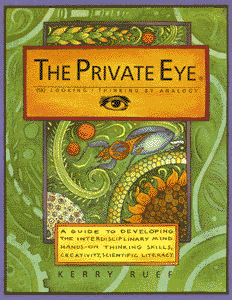
I look forward to meeting all of you over the coming weeks. Please feel free to contact me if you have any questions or concerns.'
Monday, January 26, 2015
Subtraction, Fire Safety, Social Justice, and Knitting
We have been really busy over the last few weeks. In math,
we managed to cover front end addition during the first two weeks of January.
Here's how we do it:
168 OR
100+200=300
+274
60 +
70=130
300
8 + 4= 12
130
442
12
442
We are now working on subtraction.
The subtraction algorithm we are learning is a real change from
anything that was taught in the past. It helps if the students understand
negative numbers. We discussed the idea of an elevator that can go up
from the main or zero floor or can go down to P1, P2, P3, and so on.
Those are the negative floors.
Learning this new algorithm takes time, but greatly improves ones mental math abilities.
I asked a question like this on Friday. Amy was on the 7th floor. She went down 10 floors to find her car. What floor is her car on?
Learning this new algorithm takes time, but greatly improves ones mental math abilities.
I asked a question like this on Friday. Amy was on the 7th floor. She went down 10 floors to find her car. What floor is her car on?
To help deepen this understanding, we drew giant number lines outside and then created paper ones inside.

Subtraction example 1: Normally this would involve borrowing in the 10's and the 1's.

Subtraction example 2: Notice that this time we are adding in the 10's place
because 40-10 is positive 30. Writing the + sign is not necessary, but
reminds us of what to do.

Subtraction example 3: Notice that this time we are adding in the 1's place
because 2-1 is positive 1. Writing the + sign is not necessary, but
reminds us of what to do.

I've been really impressed with the mathematical thinking in
division 7!

We also had a visit from the Fire Safety House. We were
shocked to see videos of real children doing home fire drills at night.
While some children knew what to do, others were frightened of the sound
and hid when they heard the smoke alarm. Still others went back to sleep.
We learned how important it is to practice an in home fire drill to make
sure everyone knows how to behave and exit safely.
All of the students have homework this weekend to help you look for
any potential fire hazards at home. They also need to complete a bird's
eye view of their home (if you have two or more floors, simply create a plan
for each floor). On the floor plan, students need to mark their primary
and secondary escape routes in case of fire. They also need to mark an
agreed upon family meeting place.
In social studies, we've been discussing and reading about social justice in
Canada. We asked ourselves the essential question, "How has Canada
become a more fair or just place?" Students wrote or drew about
residential schools, the potlatch, the Chinese head tax, the internment of the
Japanese during WWII, the right to vote, and women's rights. Your
children are wonderful deep thinkers and did a beautiful job of expressing
themselves.
 What a delight it has been to introduce knitting to your children. It started with just a small group of eager kids, but has grown so that now over half the class wants to learn to knit. If you have any spare yarn, knitting needles, or crochet hooks at home, or know someone who might, we would greatly appreciate your contribution. Large needles and chunky yarn seem to be the easiest to learn with.
Subscribe to:
Posts (Atom)